Revealed: Five police forces to drop Palantir surveillance tool

Paris, France - September 4, 2026 : Palantir logo displayed on a smartphone screen with stock market charts.
Palantir’s UK policing ambitions take a hit as East Midlands forces end their involvement in a controversial data pilot

By Sam Gelder for Liberty Investigates and Lucas Amin for Democracy for Sale

quotes

Five police forces in England are ending a controversial surveillance deal with the tech company Palantir, Liberty Investigates and Democracy for Sale can reveal.

They are among 12 of the 43 police forces in England and Wales reported to have been using a Palantir “real-time data sharing” tool called Project Nectar, which privacy campaigners have raised concerns about.

The five forces – Leicestershire, Derbyshire, Lincolnshire, Northamptonshire and Nottinghamshire – were part of a two-year pilot run by the East Midlands Special Operations Unit (EMSOU).

The move is a setback for Palantir. The US defence tech firm founded by Donald Trump donor Peter Thiel is also currently suing after London mayor Sadiq Khan blocked a deal between the Metropolitan Police and Palantir worth £50m in May.

Palantir’s work with UK police was uncovered by Liberty Investigates last year. Project Nectar was launched in 2023 to “help police improve how they tackle crime”, the company said, by organising data the police already hold more effectively.

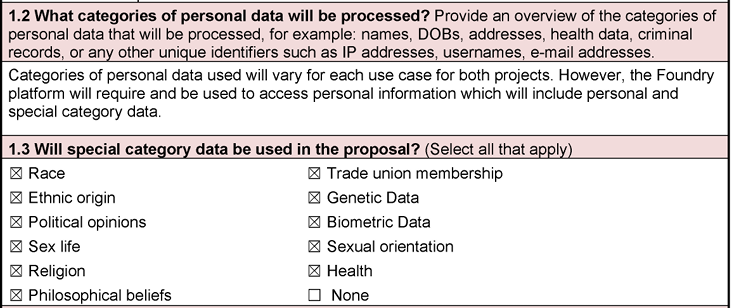
Many details remain confidential but an internal police document obtained by Liberty Investigates suggests this included creating a “unified view” of data on people’s race, religion, sex life, political opinions, philosophical beliefs and genetic information.

A screenshot of an internal police document showing what kinds of data would be processed by Project Nectar

The EMSOU pilot, led by Leicestershire, explored the use of “data federation” – the joining-up of different databases and a key selling point of Palantir – as well as “AI in policing” and “advanced analytics”. Costs were paid by the Home Office but not disclosed.

We asked EMSOU why the deal was not taken forward but it would not be drawn on details.

“We have taken the decision to not take this project further,” said Ian Green, regional assistant chief constable for the unit. This followed “scoping work,” consideration of “funding streams” and an “assessment of what it would deliver,” he added.

Liberal Democrat MP Martin Wrigley told us he was “delighted to see that police forces have seen through the sales sheen of Palantir, and concluded that they aren’t as good as they think they are”.

“The NHS should sit up and take notice and not renew their contract,” Wrigley added, in reference to Palantir’s controversial work for the NHS.

Palantir’s involvement in Britain’s public sector has emerged as a major issue for prime minister Andy Burnham. The US firm has been criticised for providing software for Donald Trump’s ICE immigration raids and the Israeli military’s “war-related missions” in Gaza.

This week Palantir hired Labour’s former deputy leader Lord Tom Watson in an effort to shore up support for its British public services work.

To date Palantir has run Project Nectar pilots in 12 of the 43 forces in England and Wales, according to a Financial Times report this month.

Seven forces in the east of England have also been using Project Nectar under a separate “rolling pilot” led by Bedfordshire Police, which has spent £3.6m on the project, according to procurement analysts Tussell.

The exact aims and operational status of the project remain unclear but the internal document we obtained shows that Bedfordshire wanted Palantir to combine crime records and other intelligence sources to create profiles of individuals including suspects and those “about to commit a criminal offence”.

Lancashire Police has also “concluded” a pilot project with Palantir and has a second contract with the company “in place for a specific use case” that “will not be extended once that work is completed,” a spokesperson told us. They would not comment on whether either of these deals related to Project Nectar.

Labour MP Bell Ribeiro-Addy, who sits on the home affairs committee, said: “The decision of a growing number of police forces to ditch Palantir shows that, contrary to the claims of proponents, the company is simply not delivering success on its own stated terms or value for money on contracts.”

Palantir faces growing scrutiny over its wider UK public sector business. Its £330m NHS Federated Data Platform contract is due for renewal in February, while two parliamentary committees have recommended the government consider using a break clause.

Internal NHS documents obtained by Democracy for Sale describe Palantir’s software as “slow and clunky” with a “poor user experience”.

Palantir did not respond to a request for comment. The company has said that Project Nectar’s software “does not involve the acquisition of any data that the customer in question doesn’t already hold – it simply organises that data in a way that enables faster, better decision-making”.

A version of this article was published by Democracy for Sale.