Police given AI tech to track ‘suspicious’ car journeys

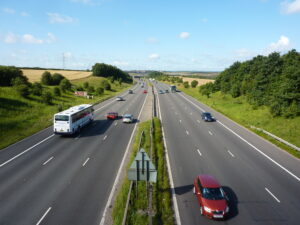
M1 motorway
The ‘find and profile’ app uses data captured by ANPR cameras to flag suspect movements

By Mark Wilding for Liberty Investigates and Charles Hymas for the Telegraph

quotes

Police forces are trialling AI technology that enables them to identify and track “suspicious” journeys by drivers on Britain’s road network.

They are using an app which analyses data collected by automated number plate recognition (ANPR) cameras, using artificial intelligence to identify vehicles that may be linked to “county lines” activity, whereby criminal gangs move drugs across the road network.

Police have until now used the UK’s network of more than 12,000 fixed and nearly 1,900 mobile ANPR cameras to generate alerts when a “vehicle of interest” passes a particular location or confirm whether a car with a specific known registration number has been recorded in the area of a crime.

The new “find and profile” app goes further in that it uses machine learning to analyse data recorded by the cameras and can track routes to identify “suspicious” journeys and vehicles to be stopped.

While the tool has so far been used to identify county lines suspects, documents obtained by Liberty Investigates and The Telegraph show police believe the technology could be deployed more widely, noting its potential to be “leveraged for different crime types”.

The documents do not specify what types of crime but a National Police Chiefs’ Council (NPCC) data protection assessment also notes: “It is possible that millions of [vehicle registrations] will be collected.”

ANPR cameras record more than 100m vehicle locations a day.

The NPCC also notes that the project “aims to test the technical possibilities which will inform decision-making about investment in further capability development and inform the ethical decision about the use of this technology”.

The app was first trialled by the North West regional organised crime unit – which covers Cheshire, Cumbria, Greater Manchester, Lancashire, Merseyside and North Wales – with funding from the Home Office. It has since been rolled out across three of the nine regional organised crime units in England and Wales.

The documents show plans are under way to roll out the tool nationally, as part of a project dubbed “Operation Ignition”, raising concerns from privacy campaigners over “mission creep” that could expose innocent drivers to intrusive surveillance.

Jake Hurfurt, head of research and investigations at Big Brother Watch, said: “The UK’s ANPR network is already one of the biggest surveillance networks on the planet, tracking millions of innocent people’s journeys every single day.

“Using AI to analyse the millions of number plates it picks up will only make the surveillance dragnet even more intrusive. Monitoring and analysing this many journeys will impact everybody’s privacy and has the potential to allow police to analyse how we all move around the country at the click of a button.

“Everybody wants county lines gangs to be tackled but there is a real danger of mission creep – ANPR was introduced as a counter-terror measure, now it is used to enforce driving rules. The question is not should police try and stop gangs, but how could this next-generation use of number plate scans be used down the line?”

Dr Xavier L’Hoiry, a senior lecturer at Sheffield University who has studied police use of the ANPR system, said many people would be unaware of the technology’s surveillance potential.

“Most people would be fine with targeted surveillance of bad actors but this indiscriminate application is when it starts to ring alarm bells,” he said.

The find and profile app is the first to be made available on the National Police Capabilities Environment, which offers police forces access to digital policing tools.

It was developed with help from the British AI start-up Faculty, which worked with Dominic Cummings on the Vote Leave campaign and has since won a series of UK government contracts with clients including the NHS and the Ministry Of Defence (MoD). Faculty declined to comment on its role in the project.

Chief constable Chris Todd, chair of the NPCC’s national police data and analytics board, said: “The National Data and Analytics Office is piloting a small-scale, exploratory, operational proof of concept looking at the potential use of machine learning in conjunction with ANPR data.

“The tooling is not integrated to the national ANPR service and is working with a very small subset of ANPR data to test the proof of concept. Its purpose is to identify vehicles of interest to support detection and enforcement action.”

He added: “Data protection and security measures are in place, and an ethics panel has been established to oversee the work.

“ANPR is used by policing to aid the prevention and detection of a variety of crime types. The current pilot is testing use of machine learning to support policing’s response to serious and organised crime. If the pilot proves to be successful, other crime types may be considered as use cases.”

Biometrics and surveillance camera commissioner William Webster said: “The Home Office is currently consulting on a legal framework to support the police use of digital and biometric technologies, which includes ANPR. Oversight is a key part of this framework, and I would argue that any future oversight regime should incorporate a ‘safe space’ and mechanisms for policing agencies to trial and pilot new technology initiatives.

“This would ensure for the future that there is transparency and accountability at the outset, and ethics and fundamental rights are integrated at the earliest possible opportunity.”

A Home Office spokesman said: “This is a policing tool designed to support investigations into serious and organised crime, which is currently being tested on a small scale.

“The application uses a small subset of data collected by the national ANPR network to help indicate criminal activity, with strong security and data protection measures in place.”

A version of this article was published with the Telegraph.