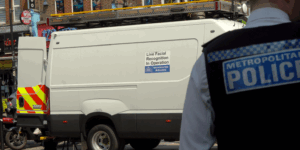
Police forces use facial recognition to track children as young as 12

van
Campaigners question the inclusion of hundreds of under-18s on the watchlists that police forces use in street surveillance operations

By Mark Wilding for Liberty Investigates and Matt Dathan for The Times

quotes

Children as young as 12 are among hundreds of under-18s included on police facial recognition watchlists, an investigation has found as ministers prepare to announce a mass expansion of the technology.

An investigation by The Times and Liberty Investigates has revealed that children have featured at least 1,600 times on live facial recognition systems used by the six forces that routinely use the technology.

However, the figure is likely to be significantly higher because three of the forces did not disclose full records in response to freedom of information requests.

It comes ahead of a key government announcement this week on plans to significantly expand the use of facial recognition. Ministers will launch a consultation on proposals to enable all 43 regional police forces and the British Transport Police to permanently use facial recognition on fixed and mobile cameras. It will set out new statutory guidelines to ensure there is a uniform use of the technology to build confidence among the public and address civil liberty concerns over a lack of regulation.

However, Dame Rachel de Souza, the children’s commissioner for England, said she was “deeply concerned” by revelations that police forces already using the technology are including footage of children on their watchlists.

She said: “It raises serious questions about why this is needed and how it is being used. “The police’s duty to protect the public must not come at the expense of the protection of vulnerable children who need care and support.”

Live facial recognition (LFR) cameras scan the faces of passers-by and compare them to photos on a watchlist of wanted people.

The Metropolitan Police has described facial recognition as a “game-changing tool”, while civil liberties advocates want to see laws restricting use of the technology.

Campaigners have raised particular concerns about children being subjected to facial recognition, highlighting the greater need to protect their privacy.

Police forces have been rapidly adopting LFR in recent months. In August the Home Office announced 10 facial recognition vans had been sent to seven forces across the country, and the British Transport Police last week said it would be trialling the technology at railway stations across London.

Backbenchers from both the Conservatives and Labour said the targeting of children illustrated the need for legal limits on the technology.

David Davis, the former Conservative cabinet minister and veteran civil liberties campaigner, said: “It has long been clear that legislation is needed. [This data] only reinforces that.” Clive Lewis, a Labour MP, described the current situation as “a regulatory wild west”, adding: “If the government does not take urgent action to protect the public by restricting its use, they will erode trust and enable authoritarian infrastructure to be built that is clearly open to abuse.”

Siân Berry, a Green Party MP, said: “It is appalling to find police using this invasive technology on children, who are particularly vulnerable to the privacy and safeguarding risks that live facial recognition carries. The government must act urgently to set conditions and limits on this rapidly spreading dystopian technology to protect our vital human rights.”

Liberty Investigates, the investigative journalism unit at human rights organisation Liberty, submitted freedom of information requests to six UK police forces that were using LFR cameras as of September 2025, asking for the number of children included on watchlists used during deployments.

The College of Policing, the professional body for police in the UK, advises that people can be included on facial recognition watchlists for various reasons, including that they are wanted by the police, by the courts, have been reported missing, or have been the victim of a crime.

It also says police “should specifically identify and document” when watchlists include photos of children, but forces appear to have interpreted this requirement differently. While some record the number of children placed on watchlists, others simply note whether watchlists included any images of children. None of the forces provided a breakdown of reasons for the children’s inclusion.

The Metropolitan Police said it was unable to provide the total number of children included on watchlists for the hundreds of deployments in London since 2022.

However, the force agreed to provide data for nine specific deployments across the capital in the past three years. Those figures reveal that an average of 105 under-18s were included on each watchlist, suggesting thousands of children may have been included overall.

A recent Metropolitan Police report revealed at least six children aged between 13 and 16 were arrested after being identified by facial recognition cameras during a 12-month period. A spokesperson for the force said under-18s made up less than 1 per cent of all individuals on its watchlists and their inclusion must be approved by an authorising officer responsible for the deployment.

South Wales Police said a total of 632 under-18s have been included on its LFR watchlists since 2022. A spokesperson for the force said children included on watchlists would be “high-risk missing persons, those wanted on warrant for an offence, or wanted in connection to high risk offences”, adding: “Due to the sensitivities of including children of any age on a watchlist, specific consideration is given by the authorising officer to the risk and proportionality of inclusion. Only in situations where significant risk is identified will someone under the age of 18 be included.”

Six of the children included on South Wales Police watchlists were under the age of 13. College of Police guidance warns police forces that studies have shown facial recognition systems to be less accurate at identifying children under the age of 13 and “may lead to more false alerts being generated against young children”. The Met Police said it had not included any under-13s on watchlists.

All four police forces that provided data confirmed they do include children on facial recognition watchlists.

Bedfordshire Police said it has included a total of 22 children on watchlists used during four deployments this year, while Hampshire & Isle of Wight Constabulary said a total of eight under-18s have been included on watchlists for four deployments. Superintendent Ian Taylor, live facial recognition lead at Bedfordshire Police, said: “We are mindful of the ethical considerations relating to the criminalisation of young people and are committed to ensuring that only juveniles wanted for the most serious arrestable offences are considered for inclusion in the watchlist. No one under the age of 13 is included.”

A spokesperson for Hampshire and Isle of Wight Constabulary said: “The reality is that there are some serious crimes committed by offenders under the age of 18 … We will also be using the technology to help find high-risk missing people, of which a significant proportion reported to us are under 18.”

Essex Police and Suffolk Constabulary said they were unable to provide figures, although Suffolk confirmed “there have been individuals aged between 13 and 18 included on the watchlists”. Both forces said they recorded the number of facial recognition watchlists that included children but not the total number of under-18s featured on watchlists.

A spokesperson for the Information Commissioner’s Office (ICO) said: “Police must ensure deployments comply with the law, protect children’s privacy, and have a clear rationale for including any individual on a watchlist. At the same time, data protection should not become a barrier to safeguarding children, careful consideration is needed to balance both. FRT remains a priority for the ICO. We note [these] findings and will review them when the report is available.”

A Home Office spokesperson said: “Police forces using the technology are required to comply with all existing laws, as well as their human rights and equality obligations, to ensure its use is lawful and proportionate.”

A version of this story was published with The Times.